Executive Summary - Specification and Supply Position
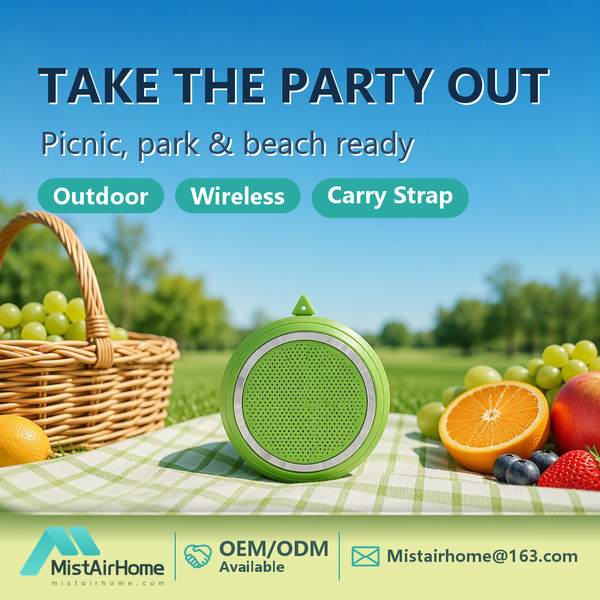
TL;DR - The Mistairhome WL-PBS01P (PRO) is a 40 mm full-range driver with a neodymium motor and a rubber surround driven by a Class D output stage with a soft-clip limiter ahead of the coil, rated 5.0 W with a 10 W peak and producing 82.8 dB at 1 m across 88 Hz to 20 kHz; the pack is 1800 mAh lithium polymer giving 12.6 hours at half volume against 103 minutes at maximum volume, recharging in 2.3 hours from empty over USB-C 5V/1A; it runs on Bluetooth 5.3, LE Audio ready out to 17 m open field with SBC and AAC and Two units pair into a left and right channel, carries IPX5 on an ABS shell with a matte soft-touch coating and a woven grille, weighs 201 g and measures 9.4 x 7.8 x 4.2 cm, and ships documented to CE / RoHS / FCC standards for import into Denmark. MOQ is 200 units per SKU with a 20-30 days lead time, FOB Shenzhen or EXW Longgang, covered by a 12 months.
China Wanlin supplies the Wireless Speaker for Women category as a direct manufacturer, not as a trading intermediary. The unit described below is one configuration out of 24 combinations (8 chassis x 3 SKU builds) that share a common driver family, a common cell supplier and a common accessory line, so a distributor can build a coherent shelf from one source rather than stitching together unrelated suppliers. Every unit referenced on this page corresponds to a specific bill of materials held on file, so the figures below can be reproduced or independently verified at sample stage.
Full specification of WL-PBS01P-PRO:
| Driver complement | 40 mm full-range driver with a neodymium motor and a rubber surround |
| Amplifier | Class D output stage with a soft-clip limiter ahead of the coil |
| Rated output, RMS | 5.0 W |
| Peak output | 10 W |
| Sound pressure level | 82.8 dB at 1 m |
| Frequency response | 88 Hz to 20 kHz |
| Passive radiator | One downward-firing passive radiator tuned to 96 Hz |
| Bluetooth version | 5.3, LE Audio ready |
| Wireless range | 17 m open field |
| Supported codecs | SBC and AAC |
| TWS pairing | Two units pair into a left and right channel |
| Hands-free calling | Built-in microphone with echo reduction for short calls |
| Battery pack | 1800 mAh lithium polymer |
| Play time at half volume | 12.6 hours at half volume |
| Play time at maximum volume | 103 minutes at maximum volume |
| Charge time | 2.3 hours from empty |
| Charge input | USB-C 5V/1A |
| Power bank output | Not fitted |
| Ingress protection rating | IPX5 |
| Control interface | Four silicone keys with a multi-function centre key |
| Enclosure | ABS shell with a matte soft-touch coating and a woven grille |
| Protection | Overcharge, over-discharge, short circuit and thermal shutdown |
| Dimensions | 9.4 x 7.8 x 4.2 cm |
| Weight | 201 g |
| Warranty | 12 months |
Shipping configuration: Pro build, + carabiner clip + mount plate + multilingual manual. Master carton holds 48 units. Stated lead time is 20-30 days from order confirmation and deposit. Accessories and spare grilles are repeat line items and are ordered separately from the appliance.
Why Buyers Are Sourcing This Category Now
Buyers in Denmark increasingly treat a small speaker as a carry-everyday item rather than an occasion item, which shifts the purchase decision from peak output towards weight, run time at the volume people actually use, and whether the unit survives being dropped once. Market entry cost is falling because small-batch first orders are now viable: a distributor can test a range without committing to full container quantities on unproven models.
What decides a Wireless Speaker for Women range is not the flagship but the middle: the model that is cheap enough to replace without discussion and good enough that nobody wants to, and getting that balance wrong is what leaves a distributor with dead stock at both ends of the shelf. This is why the table above states both a half-volume and a maximum-volume run figure: a buyer comparing two SKUs needs to see the pack capacity against the draw at each level, because that pair predicts return rates better than any other pair.
Wanlin serves Denmark through three programmes that suit different balance sheets. New partners start with sample evaluation then a mixed trial order. Established distributors move to scheduled container shipments with locked pricing windows. Brand owners run private-label programmes with their own artwork and manuals. In all three cases the factory documentation, including the certificates and battery files listed further down this page, references the specific model code on the order rather than a generic family certificate, which is the most common cause of customs delay in this category.
Engineering Notes - Driver, Enclosure and Amplifier
Three engineering decisions separate this platform from the commodity end of the category. The first is enclosure volume against driver size, because a small speaker is a negotiation rather than a specification. A 40 mm driver in a 0.25 litre box cannot reproduce a bass note; what it can do is use a passive radiator to take the rear-wave energy that would otherwise be wasted and convert it into output around the tuning frequency. The passive radiator is not a substitute for displacement, it is a way of spending the displacement the box already has, which is why the tuning frequency is printed on the specification table rather than left out.
The second is the amplifier's behaviour as the pack drains. A Class D stage running from a single-cell pack is fed by a boost converter, and the honest figures are the ones measured at the end of a charge rather than at the start. The output stages used here hold the rail flat across the discharge curve, which means the unit does not get quieter as the evening goes on, and it also means the stated output is the figure a buyer hears at hour six and not only at hour one.
The third is the limiter, and it is the trade-off buyers least expect. A limiter exists to keep the voice coil inside its travel, and when it engages the unit stops getting louder while continuing to sound clean, which a listener hears as a unit that is quiet and well made rather than loud and distorted. A competitor that omits the limiter will win a five-second showroom comparison and lose the second half of the evening, which is why the limiter setting is part of the sample evaluation we recommend rather than a detail buried in a datasheet.
Every production batch is sampled before release against four measurements: distortion at the declared output, which is held to 1 percent or better at 1 kHz, signal to noise at the preamplifier input, pack capacity by discharge test against the cell specification, and a drop onto concrete from 1.2 metres across all six faces. Cells are held to 80 percent of rated capacity after 500 cycles, and the assembly is stored and operated between minus 10 and 45 degrees Celsius. Units outside tolerance are pulled before packing, because a container of marginal units is a far more expensive problem at the destination than at the factory.
On the WL-PBS01P build documented above, that combination is a 40 mm full-range driver with a neodymium motor and a rubber surround in a sealed shell rated IPX5, driven to 5.0 W for 82.8 dB at 1 m at one metre, with 12.6 hours at half volume between charges.
Featured Deployment and Field Case Records
Featured Scenario - SC04-PATIO: Restaurant terrace with six tables and a neighbour two metres away
Operating requirement: Neighbours complain, and background music has to stay background.
How the WL-PBS01P answers it: A volume ceiling agreed with the venue rather than left to staff, a wide dispersion pattern so one low-level unit covers six tables instead of three loud ones, and an automatic shut-off at closing time. On the WL-PBS01P configuration shown above that requirement is met by 12.6 hours at half volume between charges, IPX5 on the enclosure, Two units pair into a left and right channel where two units are needed, and a 9.4 x 7.8 x 4.2 cm shell at 201 g that can be carried or clipped rather than placed. The figures quoted here come from the same specification set shown in the table above, so the numbers in this scenario and that table cannot disagree.
Field Case Records
Case Study 1: Brno, Czech Republic
Deployment: electronics distributor adding a private-label pocket speaker to an existing accessories line
Timing: first order April 2025
The distributor already sold cables and chargers, so a speaker was a natural shelf extension but a new compliance burden. The order was placed only after the Bluetooth declaration and the EMC report were reviewed by their own consultant, which is the sequence we recommend to any distributor entering the category for the first time.
Case Study 2: Busan, South Korea
Deployment: camping gear brand adding a co-branded speaker to its range
Timing: launched spring 2025
The brand's requirement was a housing colour matched to its existing tent fabric, which is a custom colour rather than a stock one. The tooling change was limited to the shell and the packaging, so the minimum for the branded order was only modestly above a stock order, and the range has since been extended to a second colour.
Case Study 3: Valparaiso, Chile
Deployment: harbour tour operator fitting speakers to a fleet of six small passenger boats
Timing: summer season 2025-2026
Commentary on a moving boat needs a voice that carries over an outboard, which pushed the order towards the higher-output model with a microphone input rather than the pocket unit the operator first asked for. Suction mounts were rejected after one week because the harbour swell worked them loose; the second order used the threaded insert and a rail clamp.
Across these deployments the pattern is consistent. Buyers who specify from measurements rather than superlatives end up with fewer returns, and the two measurements that matter are run time at the volume customers actually listen at, and whether the enclosure and the port survive the environment the unit is taken into. Everything else, including how a unit looks in photographs, affects the first order only.
Application Scenarios Across Outdoor, Work and Home Use
The same chassis family is specified into four quite different duties, and the differences are worth stating plainly because they decide which model a buyer should stock rather than which one photographs best.
| Scenario | Setting | Operating requirement |
| SC07-STROLLER | Pushchair on a gravel path with a sleeping child | The path is rough, the unit is one-handed and the listener is asleep. |
| SC03-CLIMB | Multi-pitch rock route where one hand is always on the rock | Both hands are occupied and the pack is already heavy. |
| SC09-CAB | Ride-hail vehicle doing eleven hours across two cities | Calls come through while navigation is speaking and the driver cannot look down. |
| SC05-SITE | Concrete shell of a building under fit-out, no mains power yet | Dust settles on everything and the unit gets knocked off a trestle. |
Two consequences follow for a distributor. First, a range built around one driver family and three SKU builds covers more duty than a range built around three unrelated models, because the accessory and charging line is shared. Second, the accessory is where the margin sits after the first season: carabiners, mount plates, carry cases and replacement cells repeat, while the speaker itself does not.
The shared requirement is unglamorous: IPX5 where there is water, 12.6 hours at half volume where there is no socket, and a 48-unit carton that keeps the WL-PBS01P simple to reorder for a distributor.
What a Factory-Direct Programme Changes for the Buyer
The clearest way to judge a source is to ask what happens when something has to change. On a direct programme a housing colour is a mould insert and a paint code, a manual is a print file, and a firmware change is a build the factory already owns, so each of those is quoted in days and in hundreds of units. Through an intermediary the same three requests have to travel to a factory the buyer cannot name, and the answer comes back as a new minimum quantity rather than as a schedule.
Speed matters most where a listing is already live. A marketplace seller who needs an extra thousand units before a promotion, or a distributor who has to answer a retailer's compliance question by Friday, is not placing an order so much as asking a question, and the useful answer is one that names a date. That is why the production window on this programme is stated as a number of days on the proforma rather than as an approximate range.
The second advantage is that the drawings exist. Tooling drawings, the cell specification, the acoustic test report and the radio report are held against the model code, so a buyer extending a range is working from the same documents the factory builds to instead of from a sample that may have been silently revised.
On a line such as the WL-PBS01P, the drawings cover 40 mm full-range driver with a neodymium motor and a rubber surround and the enclosure, the cell is specified at 1800 mAh lithium polymer, and the production window is 20-30 days from confirmation and deposit.
Certification, Battery Documentation and Market Access
Four faults account for almost every clearance problem we are asked to fix, and none of them is a missing certificate. The first is a certificate that names a family rather than the model on the invoice. The second is a manual in the wrong language for the destination. The third is a lithium declaration whose watt-hour figure does not match the cell actually fitted. The fourth is a consignment with no named importer on the paperwork. All four are administrative, and all four are cheaper to prevent than to explain.
The way we prevent them is to fix the file set at order confirmation rather than to issue documents against requests later. The order names the model codes, the SKU suffixes and the destination, and the package that follows contains the radio report, the EMC report, the substance declarations, the cell reports and the freight documents for Denmark, each referencing that model code. Where a buyer's own laboratory wants to retest, the technical file is supplied in full rather than as a summary.
On ingress protection, one sentence saves a lot of argument: the rating is a laboratory result for fresh water, at a stated depth, for a stated time. Salt, chlorine, steam, detergent and pressure are outside it, as is any claim about ageing. We publish the rating and its limits together, and we recommend that the listing does the same, because the alternative is a customer who believes the unit failed when it did not.
On a WL-PBS01P consignment leaving for Denmark the four things checked are the code on the carton, the manual language, the watt-hour figure on the 1800 mAh lithium polymer, and a named importer on the paperwork.
Unit Economics, Accessory Planning and Order Sizing
The landed cost of a small speaker is dominated by three things a buyer controls and two they do not. Controlled: order size, because the unit price moves meaningfully between 200 and 2000 pieces; freight mode, because a lithium shipment by air costs several times the same carton by sea; and the accessory kit, because a carry case or a mount plate can add more to the landed cost than a watt of output does. Not controlled: cell pricing, which moves with the lithium market, and the compliance cost of the destination market, which is fixed whether the order is 200 units or 20000.
Two order patterns work. The first is a mixed trial: several models in one container, each clearing its own minimum, which costs slightly more per unit and answers the question of which models actually sell in the market. The second is a single-SKU volume order once that question is answered, which is where the price sits. Distributors who skip the first step usually pay for it in the second season, in the form of stock that does not move.
On this build the numbers a buyer should hold on to are the carton quantity of 48 units, the stated 20-30 days production window, and the 1800 mAh lithium polymer pack, which determines both the freight class and the documentation set. Accessories are quoted as separate line items rather than bundled, because that is what lets a distributor reorder the parts that actually run out.
For the WL-PBS01P those three controlled variables resolve to a 48-unit carton, a 20-30 days window and an accessory list quoted on its own line, with the 1800 mAh lithium polymer deciding the freight class.
Buyer Questions Answered
Question 1: What quantity does a first pocket speaker order start at?
A single SKU starts at 200 pieces on a standard build, and at 300 pieces where the housing colour, the artwork or the manual language is being changed. A mixed container is allowed provided every model code inside it clears its own minimum, which is how most first orders are actually placed: one or two models at depth and a third at a test quantity. The WL-PBS01P ships 48 units to a master carton, so a 200-unit first line is a small number of cartons to receive and check.
Question 2: How is run time measured on these units, and is the figure repeatable?
The figure is pack watt-hours multiplied by a conversion efficiency, divided by the current measured on the bench at the stated level, and both the pack capacity and the conversion figure are printed on the table above so the arithmetic can be checked. A buyer with a USB power meter and a timer will land within a few percent of the published number, and where they do not, the discrepancy is usually a firmware setting rather than a cell. The WL-PBS01P figures are 12.6 hours at half volume and 103 minutes at maximum volume.
Question 3: Why is the top-volume play time so much shorter than the half-volume figure?
Output and current are not proportional in a small enclosure. Reaching the ceiling takes several times the current of comfortable listening, and the amplifier has to hold the rail up while doing it, so the run time collapses far faster than a linear reading of the two numbers would suggest. Publishing only the half-volume figure is how the category creates complaints, so we publish the pair.
Question 4: Can a Bluetooth speaker with the battery inside travel by air?
Air is routine for samples and for urgent top-ups, and possible for volume at a cost. The cell needs a UN38.3 report, an IEC 62133 report and an MSDS, the carton needs the lithium mark and the watt-hour figure, and the booking has to be made against a declaration that matches the model code. We issue all of that with the order rather than when the forwarder asks.
Question 5: What paperwork comes with a speaker order for our market?
Each destination has its own set, and we issue them against the model code rather than the family. Europe takes the CE technical file with radio and EMC reports plus RoHS and REACH declarations; North America adds FCC for the radio; Japan is PSE with the radio registration; Korea is KC; Australia and New Zealand are RCM. The battery set travels with every one of them because the cell is regulated independently of the radio, and consignments into Denmark name WL-PBS01P throughout.
Question 6: Is private label possible on this range, and what does it change?
Private label is the normal arrangement rather than the exception. The change is confined to the housing colour, the logo, the artwork and the printed material, so no new tooling is needed on this range and the extra minimum is small. Where a buyer wants a different accessory kit or a different retail format, that is quoted as a packaging line rather than as a product change.
Question 7: Does an ingress rating mean the unit can be left outdoors?
It covers water in the test sense: fresh, still, shallow and short. It does not cover a jet, chlorinated water, salt left to dry on the grille, or months of sun on a housing, and all four happen to portable speakers. We say so before the sale because the fix is behavioural, removable mounting and a rinse at the end of the day, and because a listing that promises more than the rating delivers is a returns problem later. The IPX5 figure on the WL-PBS01P should be quoted with those limits.
Question 8: What is the realistic timeline from enquiry to first shipment?
Existing specification samples leave in about a week, custom colour in two to three weeks, and production runs three to five weeks from confirmation and deposit. The proforma states a number of days rather than a range, and the battery paperwork is prepared during production rather than at the end of it, which is what keeps the booking from slipping.
Who This Programme Suits
Five channels buy this form factor in Denmark and each wants something slightly different. A retail chain wants carton quantities, barcodes and a manual in the local language, and cares most about what happens when a pallet is rejected. A marketplace seller wants a small first order, prep and photography that arrives ready to list, and cares most about how quickly a reorder lands. A gift and promotion buyer wants a housing colour and a box that looks like a present, and never asks about the codec at all.
The remaining two are less obvious. Rental and event companies buy durable units in bulk and value a grille that can be replaced over a housing that looks expensive. Corporate and institutional buyers buy for training rooms, site briefings and reception desks, and the deciding specification is speech intelligibility and a mount, not output. Both are steady, unglamorous volume and both reorder.
What every one of them needs from the factory is the same three things: a model code that stays available, a file set that names it, and somebody who answers a question about a specific carton rather than about the category in general. That is the service this programme is set up to provide.
In practice the buyer who suits this programme in Denmark is the one ordering WL-PBS01P against a specification rather than a photograph: 12.6 hours at half volume at the step customers use, IPX5 where it is taken, and a carton of 48 units that a warehouse can handle.
How a First Order Is Structured
Two lists make a first order painless, and they are short. The buyer provides the destination market, the importer of record, the model codes and the quantities, plus artwork and manual text where the order is branded. The factory provides the specification sheet, the certificate and battery file set named against those model codes, the carton markings, the production window and the samples. Everything that goes wrong in this category goes wrong because one of those two lists was assumed rather than exchanged.
Where a buyer has their own laboratory or their own compliance consultant, the technical file is supplied in full so it can be checked independently rather than taken on trust, and where a retailer demands a format we do not hold, we produce it against the order. That is slower than sending a summary and it is the reason a clearance does not stall later.
Wanlin supplies pocket bluetooth speaker, mini speaker, portable speaker, wearable clip speaker, car speaker, desktop speaker, rugged outdoor speaker, power bank speaker lines directly from the Longgang site and is appointing local partners in distribution, retail and online channels. Private label, custom packaging, marketplace prep and mixed containers are supported. The enquiry that gets the quickest answer names the model code, the destination and the quantity.
A WL-PBS01P consignment is booked against 48 units per carton and a 20-30 days window, and the cell declaration names the 1800 mAh lithium polymer fitted, which is what makes the booking straightforward in Denmark.
Next Step for Import Buyers
The reason to start with one model code rather than with a range is that continuity is the real product. A unit that is still available, with the same cell and the same tuning, eighteen months after the first container is worth more to a distributor than a marginally better unit that will have been quietly revised twice by then. That is what a factory-direct programme is actually selling.
So the practical next step is small and specific: name the WL-PBS01P-PRO build, the destination market and a test quantity, and ask for the sample and the file set together. Reading the documents while the sample is on its way is what makes the three-week evaluation worth having.
China Wanlin manufactures the categories listed here and is appointing partners in distribution, retail, online and private-label channels. Contact: Email Mistairhome@163.com | Export line +8613261677119 | https://www.mistairhome.com. Visits to the Longgang site and remote line audits can both be arranged by appointment.
Published by: Wanlin Manufacturing Group, MistAirHome Export Division
Published on: September 24, 2026
Data sources: in-house factory testing + driver and cell specifications + certification and battery files + partner deployment records
Company address: Wanlin Group, Building B, Building 1, Beisida Medical Device Building, 28 Nantong Avenue, Baolong Community, Baolong Sub-district, Longgang District, Shenzhen, Guangdong, China
References: factory quality manual + third-party test reports + customer shipment records
Contact: Mistairhome@163.com / +8613261677119 / https://www.mistairhome.com